Thứ Năm, 20 tháng 12, 2012

Boo Hag


          A Boo Hag is a mythical creature in the folklore of Gullah culture. It is a regionalized version of the Hag myth.


The legend


            According to the legend, Boo Hags are similar to vampires. Unlike vampires, they gain sustenance from a person's breath, as opposed to their blood, by riding their victims.[1][2][3]

They have no skin, and thus are red. In order to be less conspicuous, they will steal a victim's skin and use it for as long as it holds out, wearing it as one might wear clothing. They will remove and hide this skin before going riding.

When a hag determines a victim is suitable for riding, the hag will generally gain access to the home through a small crack, crevice, or hole. The hag will then position themselves over the sleeping victim, sucking their breath. This act renders the victim helpless, and induces a deep dream-filled sleep. The hag tends to leave the victim alive, so as to use them again for their energy. However, if the victim struggles, the hag may take their skin, leaving the victim to suffer. After taking the victim's energy, the hag flies off, as they must be in their skin by dawn or be forever trapped without skin. When the victim awakes, they may feel short of breath, but generally the victim only feels tired.

An expression sometimes used in South Carolina is "don't let de hag ride ya." This expression may come from the Boo Hag legend.[4]

It was also said that if a person placed a broom beside their bed before going to sleep it would prevent the Hag from riding them. Hags supposedly would be distracted by counting the straws of the broom and would not get to ride the person sleeping before the sun rose the next morning.[citation needed]


Thứ Ba, 18 tháng 12, 2012

Abura Akago


 Abura-akago (油赤子?, "oil baby") is a creature illustrated in Toriyama Sekien's Konjaku Gazu Zoku Hyakki, as an infant spirit lapping oil out of an andon lamp.


Sekien's accompanying notes describe it:

In the eighth town of Ōtsu in Ōmi ("Afumi") Province there exists a flying ball-like fire. (近江国 (あふみのくに) 大津の八町に玉のごとくの火飛行 (ひぎやう) する事あり。?)

The natives say that long ago in the village of Shiga there was a person who stole oil, and every night he stole the oil from the Jizō of the Ōtsu crossroads, but when this person died his soul became a flame and even now they grow accustomed to this errant fire. (土人云、むかし志賀の里に油をうるものあり、夜毎に大津辻の地蔵の油をぬすみけるが、その者死て魂魄炎となりて今に迷ひの火となれるとぞ。?)

If it is so then the baby which licks the oil is this person's rebirth. (しからば油をなむる赤子は此ものの再生せしにや。?)


Sekien seems to have based this illustration on a story from the Shokoku Rijin Dan (諸国里人談?), in which an oil merchant from Ōtsu steals oil from a Jizō statue at the crossroads, and is punished posthumously by being transformed into a wandering ghost-fire.
             Abura-akago
油赤子 (あぶらあかご)
Oil Baby
other names:


Illustrated in Sekien Toriyama's Konjaku Gazu Zoku Hyakki, this infant
which licks the oil from an andon lamp is accompanied with the following explanation:


近江国 (あふみのくに) 大津の八町に

玉のごとくの火飛行 (ひぎやう) する事あり。

土人云、むかし志賀の里に油をうるものあり、

夜毎に大津辻の地蔵の油をぬすみけるが、

その者死て魂魄炎となりて今に迷ひの火と

なれるとぞ。しからば油をなむる赤子は此もの

の再生せしにや。

In the eighth town of Ōtsu in Ōmi ("Afumi") Province there exists a flying ball-like fire.
The natives say that long ago in the village of Shiga there was a person who stole oil, and every night he stole the oil from the
Jizō of the Ōtsu crossroads, but when this person died his soul became a flame and even now they grow accustomed to this errant fire.
If it is so then the baby which licks the oil is this person's rebirth. 1


Sekien seems to have based this image on a story from the Shokoku Rijin Dan, published in 1746, in which an oil merchant who steals
oil from the Jizō statue at the Ōtsu crossroads is punished by being transformed posthumously into a ghostly flame.2


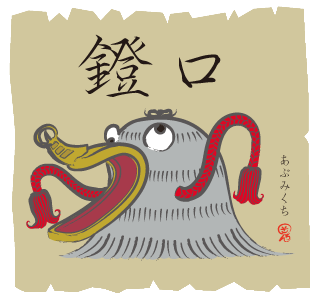
Abumi-Guchi


Abumi-Guchi
鐙口 (あぶみくち)
Stirrup Mouth


A strange furry creature formed from a stirrup, illustrated in the Gazu Hyakki Tsurezure Bukuro. The accompanying poem suggests that it once belonged to a man who has fallen in battle, and now shares in his misfortune:


膝の口をのぶかにいさせてあぶみを越して
おりたゝんとすれども、なんぎの手なればと、
おなじくうたふと、夢心におぼへぬ。
An arrow is shot deep into the knee, and he falls from his stirrups, and the hand of suffering is dealt, and such a song is sung, I saw it not in my dreaming mind.


Thứ Sáu, 14 tháng 12, 2012

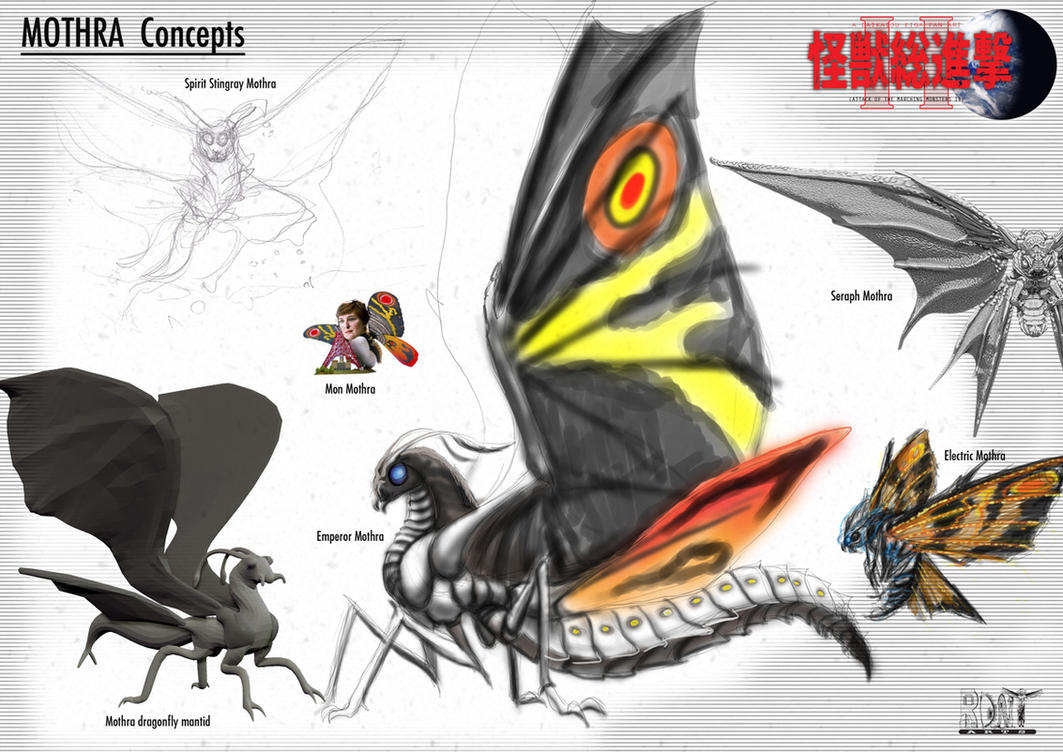
Mothra


           Mothra (モスラ Mosura?) is a 1961 Kaiju film from Toho Studios, directed by genre regular Ishirō Honda with special effects by Eiji Tsuburaya. It is the kaiju eiga debut of screenwriter Shinichi Sekizawa, whose approach to the genre grew to prominence during the 1960s. The film stars Frankie Sakai, a popular comedian in Japan at the time, and Hiroshi Koizumi, in the first of many academicroles he would adopt in tokusatsu. Jerry Ito (transliterated as "Jelly Ito" in the credits of the U.S. release) stars in the film, his only contribution to Toho's kaiju eiga genre. Ito also appeared in 1958's Japanese/US co-production The Manster (a.k.a. "The Split"), and in Toho's 1961 end-of-the-world science fiction feature Sekai Daisensou ("The Last War").

Its basic plot was recycled in King Kong vs. Godzilla and Mothra vs. Godzilla (1962 and 1964, both also written by Sekizawa), and the daikaiju Mothra would become one of Toho's most popular, appearing in seven more Godzilla films and her own trilogy in the 1990s.


Thứ Năm, 13 tháng 12, 2012

Kappa

.
Kappa(Gatarō, Kawako)


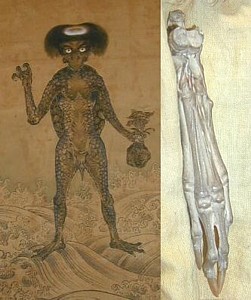
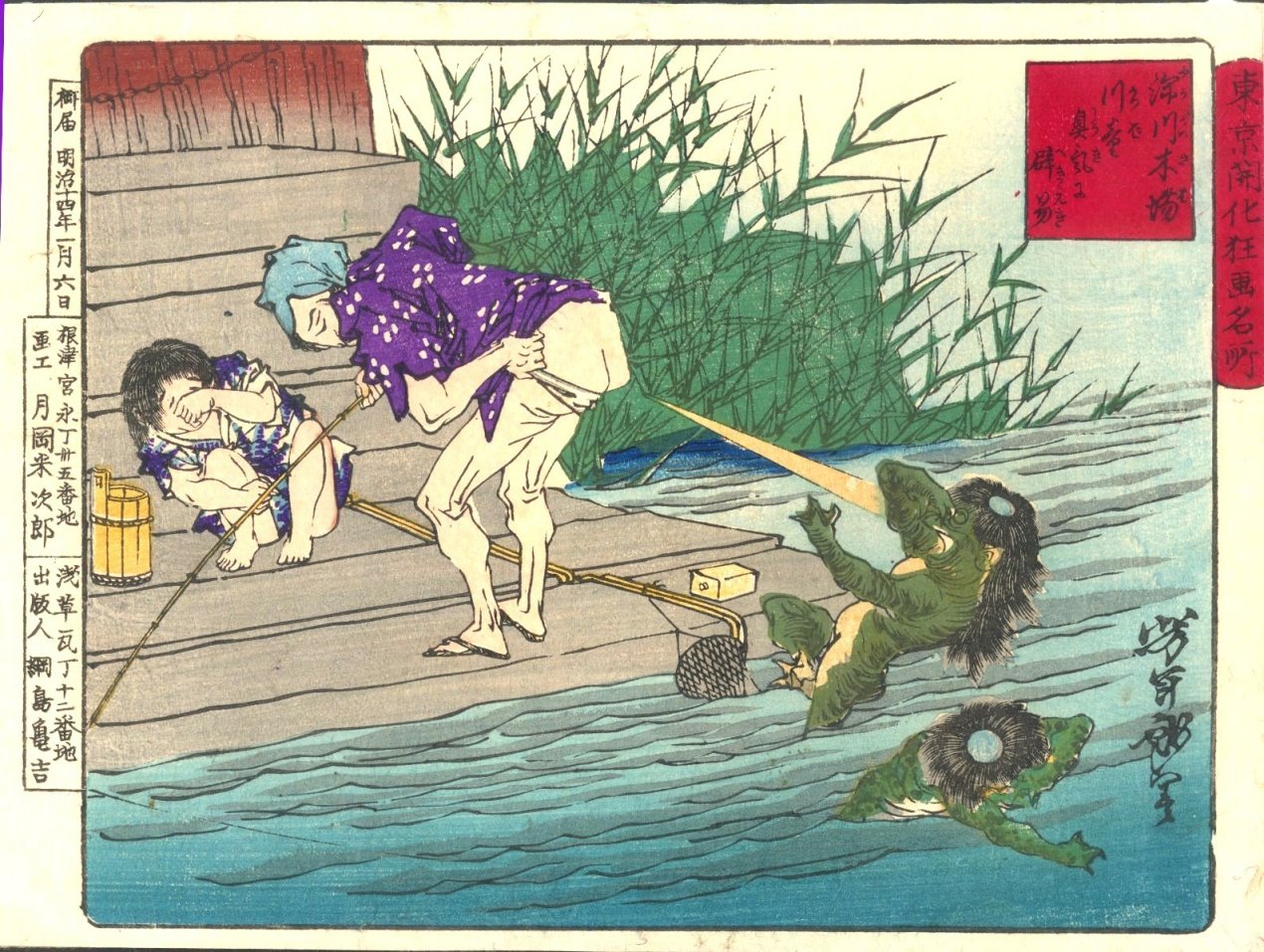
             Kappa (河童?, "river-child"), alternatively called Kawatarō (川太郎?, "river-boy"), Komahiki (“horse puller”), or Kawako (川子?, "river-child"), are legendary creatures, a type of water sprite found in Japanese folklore.[1][2][3] In Shintō they are considered to be one of many suijin(水神,“water deity”).[4] A hair-covered variation of a Kappa is called aHyōsube (ひょうすべ?).[5] There are more than eighty other names associated with the kappa in different regions which include Kawappa, Gawappa, Kōgo, Mizushi, Mizuchi, Enkō, Kawaso, Suitengu, and Dangame.[3]

Kappa are similar to Finnish Näkki, Scandinavian/Germanic Näck/Neck, Slavian Vodník and Scottish Kelpie in that all have been used to scare children of dangers lurking in waters.

It has been suggested that the kappa legends are based on the Japanese giant salamander or "hanzaki", an aggressive salamander which grabs its prey with its powerful jaws.[6]


Aobozu


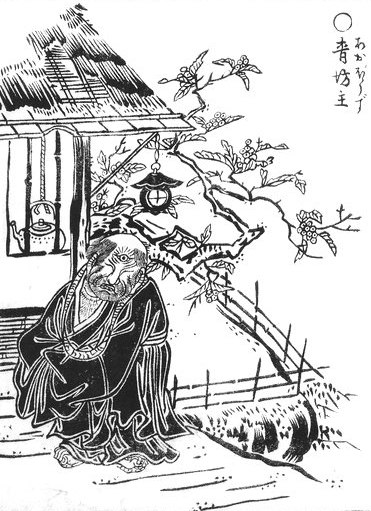
Aobōzu (青坊主 Blue Priest?) are a type of Japanese yōkai (folk legend ghosts) that appear in 18th century artist Toriyama Sekien's bookGazu Hyakki Yakō.

The aobōzu is depicted in the Gazu Hyakki Yakō as a one-eyed buddhist priest standing next to a thatched hut, however as there is no explanation of the image, the aobōzu's specific characteristics remain unknown.[2]

It is believed that the aobōzu is the direct inspiration for the one-eyed priest hitotsume-kozō that is present in many yōkai drawings, such as Sawaki Suushi's Hyakkai-Zukanpublished in 1737.[3] There is also a theory that because the kanji ao (青) in its name also means inexperienced, it was depicted as a priest who has not studied enough.[4]


Ao-bōzu

青坊主 (あおぼうず)
Green Monk
other names: Me-hitotsu-bō
          When the wheat is green, the green monk is said to emerge from the verdant fields,
and children who dally on their way home will be carried off by this monstrous bonze.
Sekien Toriyama drew the ao-bōzu as an oddly-proportioned cyclops, which may have been inspired
by other tales of one-eyed demons in priestly vestments, of which there are many.1


Umibouzu


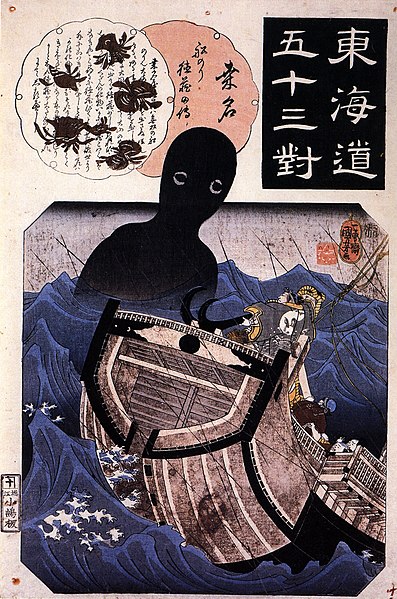
             Umibōzu (海坊主?, "sea bonze") is a spirit in Japanese folklore. The Umibōzu is said to live in the ocean and capsize the ship of anyone who dares speak to it. This spirit's name, which combines the character for "sea" with the character of "Buddhist monk," is possibly related to the fact that the Umibōzu is said to have a large, round head, resembling the shaven heads of Buddhist monks. Alternatively they are enormous Yōkai(spectres) that appear to shipwreck victims and fishermen. They are believed to be drowned priests, and exhibit the shaven head and typically appears to be praying. It is usually reported as having a grey, cloud-like torso and serpentine limbs.

According to one story, if angered, they ask that the crews provide a barrel that it proceeds to fill with sea water to drown them. To avoid this disastrous fate, it is necessary to give him a bottomless barrel.

This folktale is likely related to another Japanese tradition, which says that the souls of people who have no one to look after their graves take refuge at sea.